Knowledge Hub
Mosquito Prevention Around Homes and Workplaces in Sabah
Mosquito prevention in Sabah is important for homeowners, businesses and property managers who want to reduce mosquito breeding and activity around their premises. In Kota Kinabalu, Penampang, Putatan and surrounding areas, warm weather and frequent rainfall can create favourable conditions for mosquitoes.
Effective mosquito prevention requires more than occasional fogging. A comprehensive mosquito management programme combines breeding-site elimination, larviciding, appropriate adult mosquito treatments, property maintenance and regular monitoring.
Why Mosquito Prevention Matters in Sabah
Mosquitoes are not simply a nuisance. Certain species, including Aedes mosquitoes, can transmit diseases such as dengue. Water-holding containers, blocked gutters, discarded materials and poorly maintained drainage areas can become breeding sites around residential and commercial properties.
Understanding mosquito behaviour and identifying breeding sites are essential parts of reducing mosquito activity. Effective prevention targets different stages of the mosquito life cycle rather than relying on one treatment method.
Understanding the Mosquito Life Cycle
Mosquitoes develop through four stages:
- Egg: Female mosquitoes lay eggs in or near suitable water-holding habitats.
- Larva: The immature mosquito develops in water and feeds before progressing to the next stage.
- Pupa: The mosquito undergoes its final aquatic developmental stage before emerging.
- Adult: The mosquito emerges from the water and becomes a flying insect.
Different mosquito control methods target different life stages. Breeding-site elimination prevents development, larviciding targets susceptible aquatic stages, and adult mosquito treatments reduce adult populations. No single method reliably controls every stage.
1. Eliminate Mosquito Breeding Sites
Eliminating potential breeding sites is one of the most important mosquito prevention measures for homes and workplaces in Sabah.
Inspect the property at least once a week and after heavy rainfall. Empty, scrub, cover, turn over or dispose of containers that collect stagnant water.
Common areas to inspect include:
- Flowerpot saucers, buckets and garden containers.
- Discarded tyres, bottles and unused equipment.
- Roof gutters and drainage channels.
- Outdoor storage areas and construction materials.
- Tarpaulins and uncovered water-storage containers.
- Landscaped areas and other locations where rainwater collects.
Some mosquito eggs can remain attached to container surfaces, making regular cleaning and scrubbing important.
2. Use Larviciding to Interrupt Mosquito Development
Larviciding is an important component of professional mosquito control, particularly where standing water cannot reasonably be removed, drained or covered.
Approved larvicides may kill mosquito larvae or interrupt their development before they become biting adults. Different products work through different mechanisms, including biological activity and insect growth regulation.
Not every larvicide controls mosquito eggs or pupae. Some formulations primarily target larvae, while certain other products may affect additional aquatic stages. The appropriate treatment depends on the product, mosquito species, breeding habitat and site conditions.
Professional larviciding should be based on site inspection, approved product-label requirements and appropriate monitoring. Pesticides should not be introduced into drinking water or sensitive aquatic environments unless the specific product is authorised for that use.
3. ULV Cold Fogging for Adult Mosquito Control
ULV cold fogging, or ultra-low-volume fogging, is a mosquito-control method that disperses fine insecticide droplets through the air to target exposed adult mosquitoes.
This method may be appropriate as part of a targeted adult mosquito management programme when inspection findings, mosquito activity and site conditions justify treatment.
Its effectiveness depends on several factors, including equipment calibration, droplet size, weather conditions, mosquito behaviour and the insecticide formulation used.
Conventional ULV cold fogging is primarily a space-treatment method. It should not automatically be described as creating a lasting insecticide coating on exterior walls. It also does not eliminate mosquito eggs, larvae or pupae developing in water.
4. Thermal Fogging for Mosquito Management
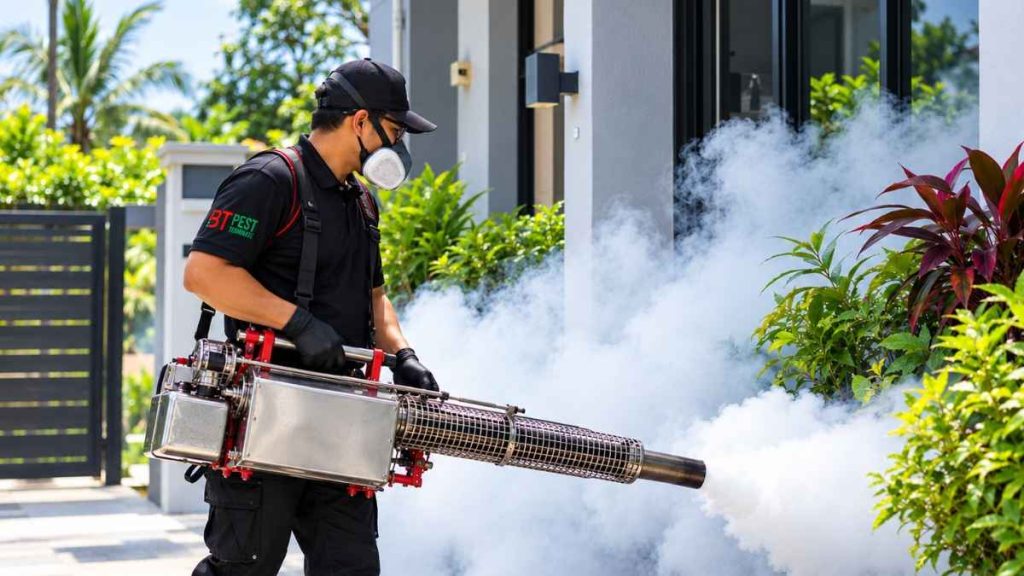
Thermal fogging is another method of adult mosquito control. Thermal fogging equipment uses heat to produce a visible fog containing an appropriate insecticide formulation.
Unlike cold fogging equipment, thermal foggers create a highly visible fog. However, the amount of visible fog does not, by itself, indicate treatment effectiveness.
Thermal fogging may be considered under suitable circumstances as part of a broader mosquito management strategy. Treatment planning should account for weather, application conditions, equipment suitability, product-label directions and surrounding environmental sensitivities.
Thermal fogging targets exposed adult mosquitoes but does not replace breeding-site elimination or larviciding.
5. Residual Exterior Surface Treatment
Some mosquito management programmes may include residual insecticide treatment on suitable surfaces where adult mosquitoes rest.
Unlike conventional space fogging, an approved residual application is intended to leave an insecticide deposit on specified surfaces. Susceptible mosquitoes that subsequently contact those treated surfaces may be affected by the insecticide.
Whether a residual treatment is suitable depends on the registered product, approved application method, surface type, weather exposure and site assessment.
Not every ULV or thermal fogging formulation is suitable for residual application. The treatment should follow the relevant product label and should not be presented as a guarantee of immediate mosquito elimination.
6. Mosquito Prevention for Workplaces in Sabah
Mosquito prevention is also important for commercial properties, including offices, restaurants, warehouses, construction sites, educational institutions and industrial premises.
Property managers and maintenance personnel should regularly inspect roof gutters, perimeter drains, landscaped areas, outdoor storage containers, loading bays and waste disposal areas.
Where mosquito activity is recurring, a documented management programme can help identify problem areas, assign corrective actions and monitor the effectiveness of preventive measures.
Maintaining window screens, reducing mosquito entry points and encouraging appropriate personal protection can provide additional benefits.
7. Build a Long-Term Mosquito Prevention Programme
Effective mosquito control requires ongoing attention rather than relying entirely on individual treatment visits.
An integrated mosquito management programme may include:
- Regular inspection and identification of mosquito breeding sites.
- Removal or management of standing water.
- Appropriate larviciding at suitable aquatic habitats.
- Targeted ULV cold fogging or thermal fogging where justified.
- Approved residual surface treatments where appropriate.
- Follow-up monitoring and environmental maintenance.
The appropriate combination of measures depends on the mosquito species, the condition of the premises, infestation patterns and relevant public-health guidance.
Frequently Asked Questions About Mosquito Control
Does ULV cold fogging leave a protective coating on exterior walls?
Not necessarily. Standard ULV cold fogging primarily targets exposed adult mosquitoes through airborne droplets. Residual surface treatment requires an appropriate product and approved application method.
Does larviciding kill mosquito eggs, larvae and pupae?
Not every larvicide controls all three stages. Its effectiveness depends on the active ingredient, formulation and mode of action. Eliminating breeding sites remains essential.
What is the difference between thermal fogging and ULV cold fogging?
Thermal fogging uses heat to produce a visible fog, while ULV cold fogging mechanically disperses fine droplets without relying on heat to create the fog. Both can be used for adult mosquito control when appropriate.
Is mosquito fogging alone enough to prevent dengue?
No. Fogging cannot guarantee dengue prevention. Breeding-site reduction, appropriate larval management, bite prevention and public-health measures are also important.
How often should mosquito breeding sites be inspected?
Weekly inspections and additional checks after heavy rainfall are practical starting points. Properties with recurring mosquito problems may require more frequent monitoring.
Professional Mosquito Control in Kota Kinabalu and Sabah
BT PEST TERMINATE provides professional pest management services for residential and commercial premises in Kota Kinabalu and other serviced areas across Sabah.
Our approach focuses on identifying mosquito concerns, understanding the conditions around each property and recommending appropriate mosquito management measures based on inspection findings.
Learn more about our professional pest control services, or contact BT PEST TERMINATE to discuss mosquito activity around your home or workplace.
For additional public-health information, refer to the World Health Organization’s dengue prevention guidance.
BT PEST TERMINATE — WE GIVE PEACE OF MIND.